Engineering the Future of Software: How Teams Can Build Ahead of the Curve



The software industry is at a pivotal crossroads. AI is no longer just a novelty or side gadget—it’s revolutionizing the very way software is conceived, built, and maintained. Over 80% of developers now lean heavily on AI assistance daily. The question isn’t if AI will transform software engineering—it’s how fast teams will embrace it and how deliberately they’ll do so.
At Dualboot Partners, we see the future of software development as something to be proactively shaped, not passively waited for. The winners will be those who harness AI’s power with sharp engineering judgment, unwavering architectural discipline, and keen business insight.
An Industry in Transition
In “The Next Two Years of Software Engineering,” Google engineering leader Addy Osmani outlines what many organizations are already experiencing: the definition of a “great engineer” is changing.
Speed of writing code matters less. Judgment matters more.
As AI absorbs more of the routine implementation work, long-term value shifts toward:
- System design and architecture
- Critical thinking and trade-off analysis
- Knowing when to trust AI — and when to override it
- Connecting technical decisions to real business outcomes
This evolution is shaping not only individual engineering roles, but also how teams are structured, how projects are planned, and how software organizations create value.
Moving Beyond AI Hype to Real Capability
One of the biggest risks in today’s market is confusing AI adoption with AI maturity.
Many teams experiment with copilots or prompt-driven workflows, yet struggle to turn those experiments into sustained delivery improvements. Real advantage comes from treating AI as part of the system — not a shortcut.
That means:
- Using AI to understand and navigate complexity, not just generate code
- Embedding AI into discovery, documentation, and design — not only development
- Maintaining strong architectural ownership, even as execution accelerates
AI is most powerful when it helps engineers make better decisions. It becomes risky when it replaces decision-making altogether. This distinction is critical to the future of software engineering with AI.
What the Future Demands from Engineers
As AI becomes a standard part of the engineering toolkit, expectations for engineers are rising — not falling.
From Implementers to Orchestrators
Engineers are increasingly responsible for orchestrating systems rather than manually building every component. This requires comfort with abstraction, interfaces, and system-level thinking, even when AI handles large portions of execution.
T-Shaped Skill Sets Win
Deep expertise in one area, combined with broad understanding across the stack, is becoming the most resilient profile. AI allows engineers to operate more broadly — but only if they understand enough to validate and guide its output.
Continuous Learning Is Now Table Stakes
Tools evolve every few months. Frameworks rise and fall. The ability to learn, unlearn, and adapt quickly is now as important as any specific technical skill.
Practical Guidance for Engineers in an AI-Driven Industry
Across industries and company sizes, the same patterns are emerging among high-performing teams preparing for the future of software development:
- Use AI deliberately
Treat AI as a collaborator, not an authority. Validate outputs, question assumptions, and understand the reasoning behind generated solutions. - Experiment responsibly
Adopt new tools and workflows within clear engineering standards. Measure success not just by speed, but by quality, maintainability, and long-term impact. - Think beyond implementation
As AI accelerates coding, human value shifts toward architecture, system boundaries, scalability, and cost over time. Engineers who think in systems will stand out. - Anchor decisions in business context
The best solutions are not always the most elegant ones. They are the ones that solve the right problem. Understanding business impact is becoming a core engineering skill. - Share what works — and what doesn’t
AI-driven practices improve fastest in open, collaborative environments. Teams that share lessons learned adapt far more quickly than those working in isolation.
Why Dualboot Is Already Ahead
While many organizations are still experimenting with AI in isolated ways, Dualboot began investing early, not in hype, but in practical, production-ready capabilities.
3PO: Turning Complexity into Clarity
We built 3PO to solve a real and persistent problem: understanding complex systems. From reverse-engineering legacy codebases to generating technical specifications, 3PO saves weeks of discovery work. This isn’t a demo. It’s a tool shaped by real delivery constraints.
DB90: An AI-First Development Ecosystem
DB90 is our ecosystem for integrating AI across the software development lifecycle where it actually adds value. It’s not about replacing developers. It’s about amplifying them — embedding AI into discovery, design, development, and decision-making in a way that’s structured, intentional, and measurable.
AI-Assisted Development at Scale
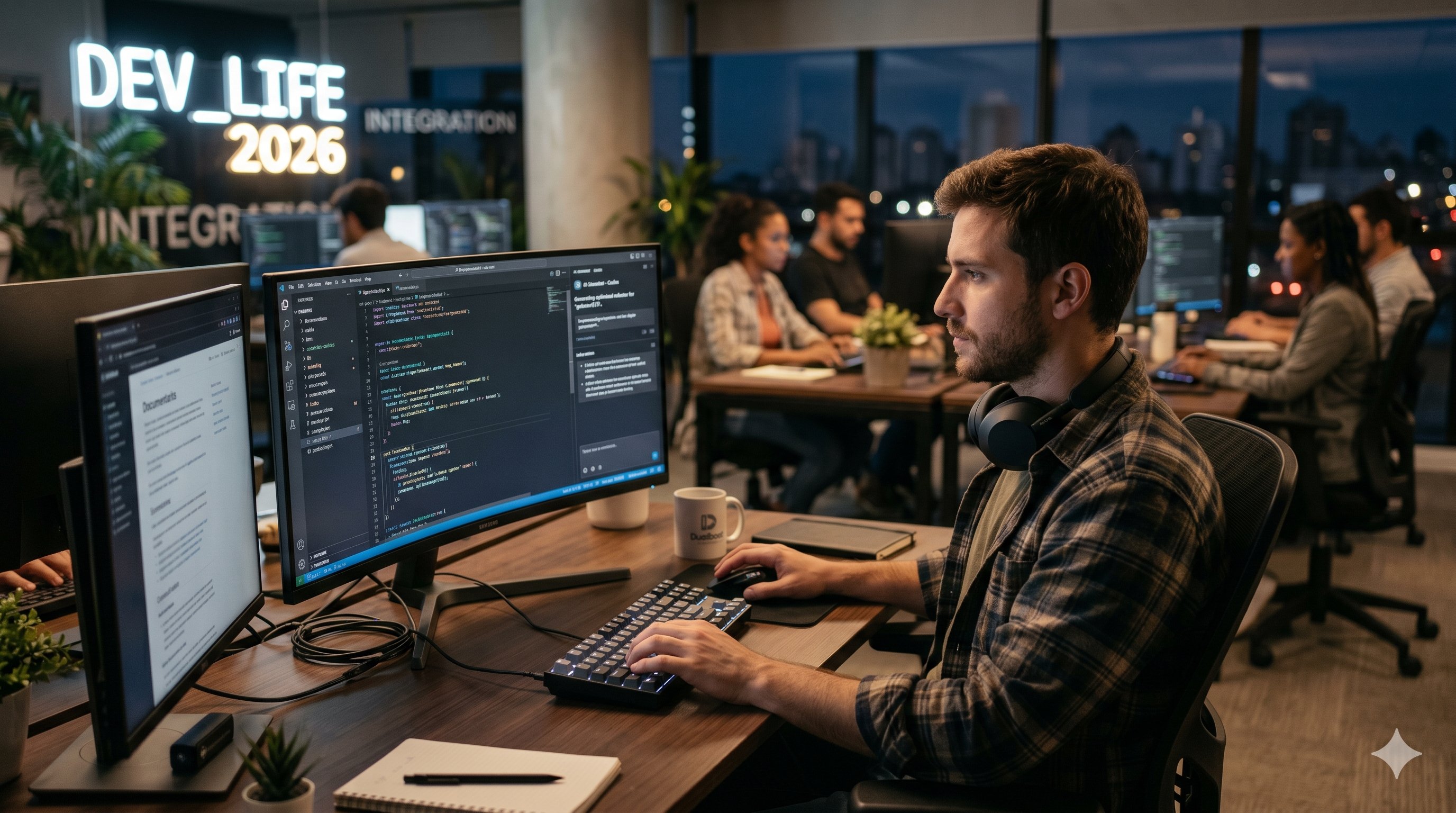
We didn’t limit AI adoption to a small group or innovation lab. Tools like Cursor were rolled out company-wide, and teams quickly began seeing results. Projects such as Executive-IQ demonstrated what’s possible when AI-assisted workflows are fully embraced rather than cautiously avoided.
If you’re looking to accelerate that shift within your own organization, our AI Strategy Workshop is designed to help teams move from experimentation to execution at scale.
What This Means for Clients and Teams
For organizations building software today, the takeaway is clear: AI alone is not a strategy.
The real differentiator in the future of software engineering is how effectively teams combine AI acceleration with strong engineering fundamentals, architectural rigor, and business understanding.
The future won’t be defined by tools alone. It will be shaped by teams that learn how to use those tools with intention.
The best way to predict what comes next remains the same: actively engineering it.
Let’s keep building.
FAQs
Will AI replace software engineers in the future?
AI will not eliminate software engineers, but it will significantly reshape their roles. As AI handles more routine coding tasks, engineers will spend more time on system architecture, problem-solving, and strategic decision-making. In the future of software engineering with AI, the most valuable engineers will be those who know how to work alongside AI rather than compete with it.
What does the future of software development look like with AI?
The future of software development is AI-assisted, but human-led. AI will accelerate implementation, testing, and documentation, while engineers focus on higher-level concerns such as scalability, maintainability, and business impact. Teams that adopt AI thoughtfully — without sacrificing engineering discipline — will be best positioned for long-term success.
How is Dualboot Partners preparing for the future of software engineering with AI?
Dualboot Partners prepares for the future of software engineering by embedding AI into real delivery workflows, not experiments. Through tools like 3PO and the DB90 AI-first development ecosystem, Dualboot uses AI to improve system understanding, reduce discovery risk, and help engineers focus on higher-value work rather than routine tasks.


Related Posts