

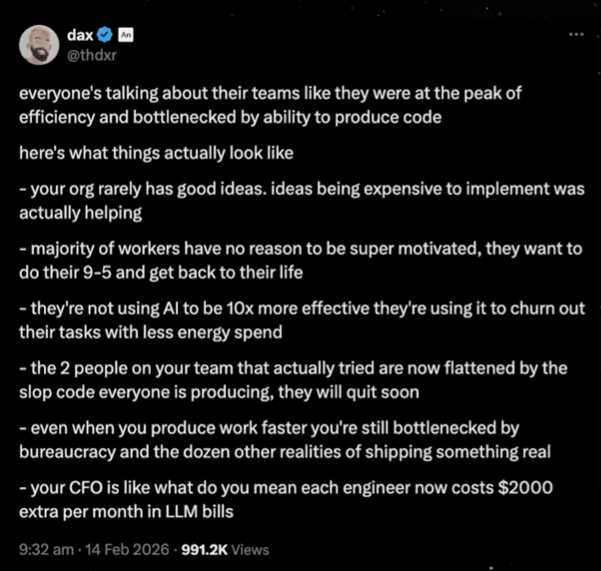
Early in February, Dax Raad (@thdxr) from the OpenCode team shared some thoughts on X regarding this new era of AI code generation. It really struck a chord with me. His take felt hype-free, on point, and grounded in the actual reality of leading development teams today, which motivated me to share my own perspective with the team.
The “Coding is Solved” Narrative vs. Reality
Let’s dive in. First, consider the context: this post appeared right as the head of Claude Code claimed in a podcast that “coding is solved.” We’ve all heard the talking points by now: “Developers rely fully on Claude,” “they haven’t touched code since last November”, “agents are running autonomously,” and “productivity has increased 200%.” The claim is that soon, knowing how to write code won’t even matter because everyone will be able to do it.
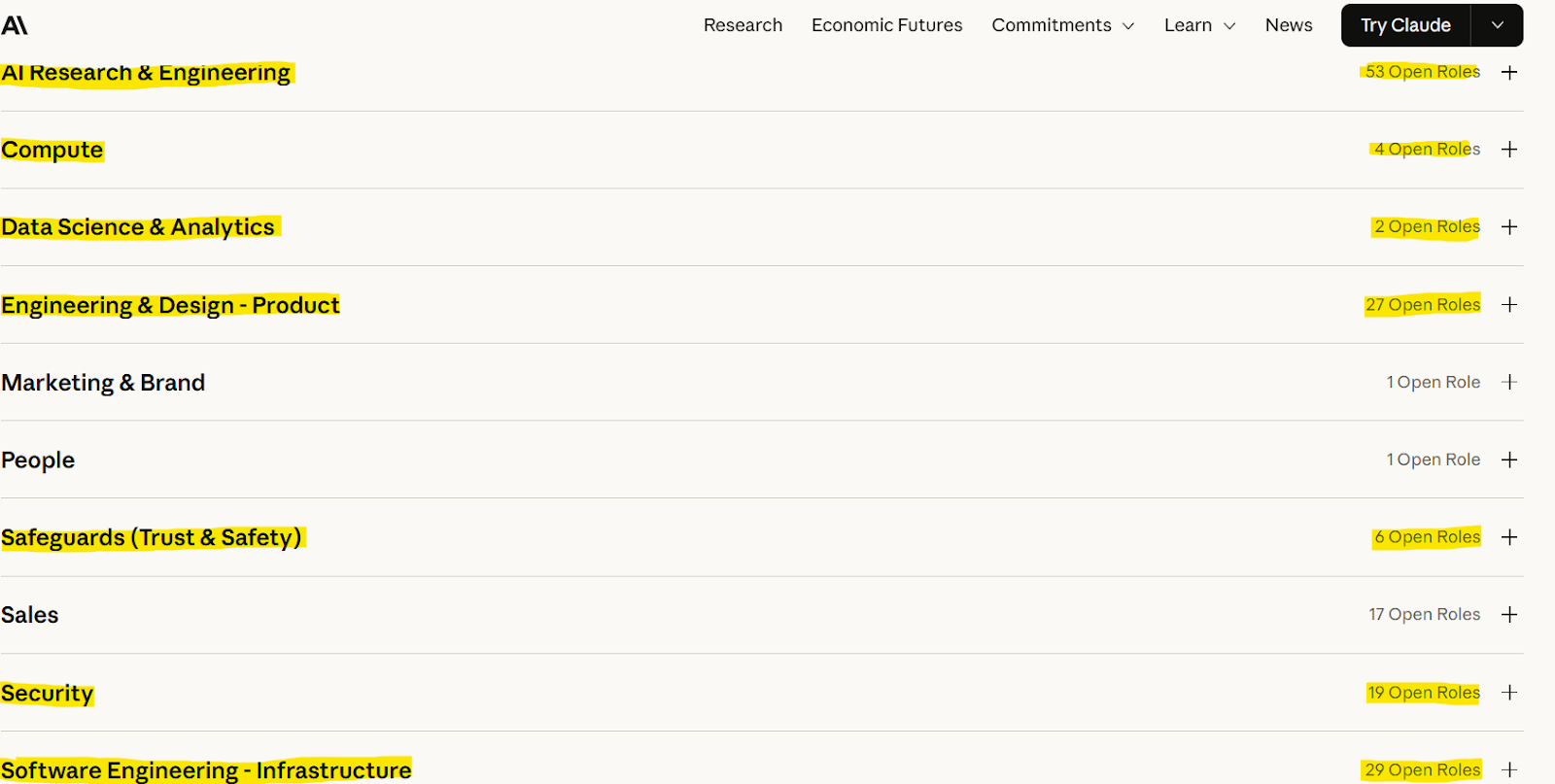
What’s funny is that these statements come from the owner of a repository with close to 6,000 open issues. Meanwhile, Anthropic is hiring over 100 software engineers. If coding is “solved,” why is the demand for human expertise still so high?

The Bottleneck was Never Just Writing Code
As impressive as AI tooling is becoming, we are all getting tired of the hyper-inflated narratives used to attract investors. That’s why this take might be such a breath of fresh air:
“Everybody is talking about their teams like they were at the peak of efficiency, suggesting the bottleneck was the ability to produce code.”
This is a key observation. All the focus is currently on the number of lines produced by the latest shiny model, as if that were the holy grail of software development. My experience has taught me otherwise: building software products is so much more than writing the code. Coding was never the biggest issue in this equation to begin with.
Coding has always been a task, not the job. The job is, and will be, software engineering, which I strongly believe will always have humans at the center, using AI as a fantastic accelerator. We’ve had modern frameworks abstracting the “hard wiring” for over a decade, and no-code tools have been around for years with zero dent in developer demand. If removing code were the silver bullet, the industry would have already shrunk; instead, it has only expanded.
The Value of Constraints and Product Discipline
Another great point from the tweet: Not every feature idea is a good idea. In the past, the fact that ideas were “expensive” to implement helped us (and our clients) refine and purge scope.
That time constraint forces teams to prioritize, polish, and cut. At Dualboot, we don’t win because we generate code faster than others; we win consistently because we help clients make sharp product decisions under constraints. We say “no” to a thousand tempting scope creep attempts to ensure we solve the right problems within budget.
Don’t get me wrong, I’m 100% on the AI train. So far, AI is proving to be a fantastic tool, and it’s getting better every day. But we must be careful during this paradigm shift to maintain the core values we provide. Delegating the right tasks to AI is an absolute win; delegating too much means all of this goes away as the constraint to produce code slowly disappears.
Jevons Paradox and the Real Impact of AI
If the marginal cost of shipping features drops to zero and we let our discipline collapse, we risk replacing well-thought-out software with 1,000 half-baked ideas that become a nightmare to maintain.
The true impact AI will have is best explained by the Jevons Paradox: as a resource becomes more efficient to produce, we don’t use less of it; we find infinite new ways to use more of it. Development teams will get busier than ever. As the cost of generating software drops, the surface area of software expands—more internal tools, more automated processes, and more experiments. We will be more needed than ever to ensure the right things get created the right way.
Adapting the “Engineering Muscle”
Dax pointed out: “They’re not using AI to be 10x more effective, they’re using it to churn out their tasks with less energy spent.”
Good use of AI tooling won’t magically make everyone 100x more performant. Instead, it allows us to churn out our current coding tasks with less energy spent, liberating mind space for more important things. Who wants to write their 1002nd CRUD when they can delegate it to an agent while they start planning a much more exciting feature?
As the industry keeps framing AI as a multiplier of raw ambition and productivity, the reality I see is that it will become a reliable energy saver for our team members. A smart companion for automation of certain tasks, that will take more repetitive work off our plates, leaving us more space to focus on product and software engineering, rather than a simple 100x code-writing productivity (or replacement) it’s always presented as.
Coding, despite the mythology, is the easy part. Writing syntax is mechanical and even fun. When you write code yourself, you are forced to simulate the system in your head: understanding why each function exists, what assumptions it makes, and what state it mutates. As this layer gets outsourced, that mental training must not disappear; it has to mutate into better up-front design and rigorous review.
The hard part remains modeling problems correctly, defining boundaries, and designing systems that survive change. We will still ship features and close tickets, but we must find new ways to exercise the muscles required to reason about complexity within the “plan/review/refine” flow.
Logic Over Hype
The full impact AI will ultimately have on software development is still unfolding. However, seeing companies like IBM triple their entry-level hiring after realizing that replacing juniors creates long-term talent gaps is a clear indicator: as the hype settles, logic is seeping back into the industry.
AI is a fantastic, transformative tool, and it’s here to stay. It’s up to all of us to make sure we use it well and define what the next era of software development looks like.