
Technical debt is no longer an IT issue. It’s a barrier to your growth.


AI Readiness Gap:
Low code quality and fragmented data make AI implementation unreachable.
Operational Inertia:
Much like financial debt, interest builds up until maintenance consumes the budget for the future.
Systemic Risk:
Fragility that compromises security and modern customer experiences.
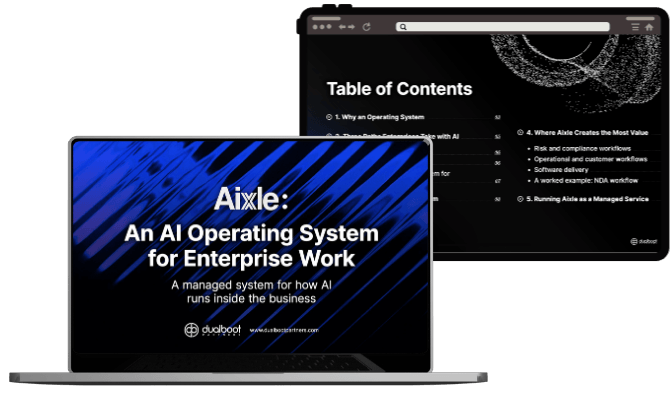
Table of Contents
The Strategic Burden:
Why Technical Debt is a Business Constraint
Business Impact:
Where Technical Debt Surfaces First
The Dualboot Method:
A Framework for Strategic Modernization
AI Readiness:
Preparing Your Infrastructure for the Future
Tactical Playbook:
How to Start Without Halting Operations
FAQ:
Common Questions on Managing Technical Debt
Technical Debt Is Not a Maintenance Problem. It Is a Growth Constraint.
The Innovation Barrier
of IT leaders say infrastructure complexity is the biggest impediment to next-gen services. (WSJ)
The Financial Burden
Trillion is lost annually due to cybersecurity, operational failures, and legacy maintenance. (WSJ)
The Budget Drain
of IT budgets are currently trapped in legacy infrastructure and application maintenance.
of organizations see technical debt as a high-impact barrier to their ability to innovate.
of Prevention is 2x more efficient than resolving accumulated debt after a system failure.
Why the Interest on Debt is Increasing in 2026
Poor data structures prevent modern machine learning integrations.
Software development slows as teams struggle with inadequate testing and poor design decisions.
Technical debt management isn’t about achieving “perfect code”; it’s about reclaiming the 42% of your budget currently wasted in the past.
Technical Debt Is Not Invisible.
It Surfaces as Stalled Innovation.
Technical debt rarely appears as a single visible failure. It surfaces as stalled initiatives, fragile systems, and missed opportunities across the business.
Organizations often recognize the symptoms long before they identify the root cause.
AI Initiatives That Fail to Scale
Many teams invest in AI with clear expectations: faster workflows, better decisions, and lower operational cost. But when AI is layered on top of broken processes or undocumented systems, it accelerates friction instead of removing it.
- Clinical burnout persists.
- Engineering velocity drops.
- Automation creates new risks instead of measurable value.
In these cases, the blocker is not the AI model. It is the technical debt underneath it.
We examine how this structural friction leads to The Velocity Trap, where engineering effort is consumed by maintenance instead of innovation.
In specialized sectors like healthcare, we’ve seen how addressing technical debt is the only way of Reclaiming the Bedside, ensuring that automation actually reduces clinical burnout instead of adding to it.
Legacy Systems That Block Modernization
- Dependencies are unclear.
- Automated tests are missing.
- Downtime risk feels unacceptable.
As a result, modernization efforts stall before they begin, and organizations remain locked into systems that limit scalability, integration, and resilience. Technical debt becomes an operational constraint rather than a background concern.
This state of “Digital Rust” eventually paralyzes the organization. Our Digital Rust Breaker framework provides a path to identify technical debt and clean up the
legacy foundations that stall modernization efforts.
For those integrating AI assistants, we explore how to turn these “black box” systems into a Glass Box Copilot by restoring visibility and logic to the underlying codebase.
Fragmented Data That Breaks Customer Experience
In consumer and retail environments, technical debt often appears as disconnected journeys rather than failing systems.
- Customer data lives in silos.
- Inventory visibility is incomplete.
- Digital and in-store interactions cannot stay synchronized in real time.
The outcome is not only inefficiency. It is lost revenue, reduced loyalty, and invisibility in emerging AI-driven discovery channels.
As the market shifts toward Agentic Commerce, only organizations that manage technical debt effectively will be able to support the autonomous, AI-driven discovery channels that are redefining modern retail.
The Pattern is Consistent: Whether it’s AI slowing down or system modernization stalling, these aren’t isolated bugs. They are the result of failing to manage technical debt before it grows beyond the engineering layer and becomes a business constraint.
A Strategic Framework for Debt Reduction and System Modernization
Reducing technical debt is not a one-time project; it is a sequence of calculated decisions that balance risk, speed, and long-term value. Dualboot approaches technical debt management through three coordinated pillars: Visibility, Modernization, and Prevention.
AI-Led Discovery: Turning Black Boxes into Clear Maps
Most organizations delay addressing technical debt because they lack a clear map of their legacy systems. Undocumented dependencies and outdated languages like COBOL or VB.NET create a “fear of change.”
Before writing new code, we use 3PO, our proprietary AI-driven analysis platform. 3PO ingests legacy codebases to automatically identify technical debt and generate:
- System Documentation & Dependency Mapping
- Entity-Relationship Diagrams (ERDs)
- User Stories and Business Logic Flows
This transforms opaque debt into a transparent modernization blueprint, replacing assumptions with data-driven confidence.
Strategic Modernization: High-Impact Debt Reduction
We don’t believe in “rip and replace.” Dualboot applies contextual strategies to manage technical debt based on business impact:
- Refactoring: To stabilize fragile codebases and improve code quality.
- Replatforming: Moving legacy applications to scalable, cloud-native architectures (Azure, .NET Core, Ruby on Rails).
- The DB90 Ecosystem: We structure system modernization into focused 90-day sprints, delivering measurable outcomes—like significant bug backlog reduction—early in the journey.
Prevention Through Quality Engineering
Paying down debt is only half the challenge; preventing new technical debt is more efficient than resolving existing debt later. We protect your long-term velocity by addressing the root causes: rushed coding, inadequate testing, and poor design decisions.
To manage technical debt effectively, we embed quality directly into the software development lifecycle:
- Automated Tests: We implement unit, integration, and end-to-end tests within a CI/CD pipeline to catch regressions early.
- Budget Realignment: Currently, 42% of IT budgets are tied up in legacy infrastructure and maintenance. Our goal is to shift that capital back toward innovation.
- Quality Standards: Tech debt accumulates when short-term goals are prioritized over long-term quality; we embed code quality checks into every sprint to break that cycle.
AI Adoption Is an Infrastructure Challenge, Not a Model Problem.
AI adoption is accelerating across every industry, but successful implementation depends on a foundation that most legacy systems simply cannot support. To manage technical debt effectively in 2026 means recognizing that your AI strategy is only as strong as the code it sits upon.
For AI to deliver measurable value, it requires:
- Data Integrity: Clean, structured, and accessible data—often blocked by low code quality.
- Observability: Traceable logic and governance that technical debt often obscures.
- Modular Architecture: Systems that allow for the safe integration and rapid iteration of machine learning models.
When these conditions are missing, AI doesn’t create efficiency; it introduces operational risk and unreliable outcomes. This is why many AI programs stall after the pilot phase. The limitation is rarely the AI model itself, but underlying technical debt and fragmented software development practices.
Addressing technical debt is not a separate initiative from your AI strategy; it is the prerequisite.
Organizations that prioritize debt reduction and automated tests move from experimentation to impact far faster than those who layer modern tools over brittle foundations.
Preparing your systems for AI begins with identifying technical debt within them today.
The Measurable Impact of Addressing Technical Debt
Faster Execution Without Fragile Systems
When undocumented dependencies and unstable codebases are stabilized, teams recover lost engineering capacity.
- Bug backlogs shrink.
- Release cycles accelerate.
- New features reach production without increasing operational risk.
Operational Efficiency That Compounds
Much like financial debt, the interest on legacy systems hides in manual workflows and slow processes. Once you manage technical debt effectively:
- documentation time drops
- system performance improves
- support overhead decreases
Real Readiness for AI and Modern Platforms
The most important shift appears when organizations move from AI experimentation to AI in production. With high code quality and modular services, AI outputs become traceable and auditable:
- integrations deploy safely
- compliance risk decreases
- new capabilities reach users faster
Reducing Technical Debt Without Halting Operations
How do you identify technical debt and fix it without killing your velocity? Here is a tactical playbook for technical debt management that fits into your existing software development lifecycle:
- Explicit Capacity: Allocate 15–25% of every sprint to technical debt items with clear acceptance criteria.
- Static Code Analysis: Use tools to measure technical debt in person-hours, making the cost concrete.
- The Boy Scout Rule: Leave the code cleaner than you found it. Small, incremental refactors compound over time.
- Automated Tests as a Safety Net: Ensure all debt reduction spikes are backed by automated tests to prevent regressions.
- Aligned Refactoring: Address debt in the specific modules you are already touching for new feature development.
Where to Start:
A Roadmap for Addressing Technical Debt
Most organizations know technical debt is slowing them down, but they lack the visibility to know where the real risk lives. The safest way to reduce technical debt is not a blind “rip-and-replace” gamble; it is a structured transition from visibility to action.
 Step 1
Before you can manage technical debt, you must be able to see it. With 3PO, our AI-powered legacy code translator, we automatically document hidden dependencies and legacy logic to identify technical debt.
This process eliminates the “fear of the unknown” by transforming unclear codebases into transparent modernization blueprints.
By first mapping out entity relationships and business flows, we ensure that your debt reduction strategy is based on objective data and high-value business outcomes rather than guesswork.
 Step 2
Reducing technical debt requires contextual modernization. We help you choose the right path based on risk and ROI:
- Refactor: Improve code quality within the existing architecture to stabilize fragile systems. (e.g., EntityKeeper reduced bug backlogs by 90%).
- Replatform: Move to modern cloud stacks (Azure, AWS, Rails) to eliminate infrastructure bottlenecks. (e.g., Boardroom Insiders eliminated scaling friction).
- Rebuild: Start from scratch only when the architecture cannot support 2026 software development demands.
 Step 3
To mitigate the risk of system modernization, we avoid multi-year “waterfall” projects, which often fail to deliver value. Our DB90 ecosystem organizes the process into 90-day sprints with clear KPIs.
Using the Strangler Fig pattern, we safely wrap legacy systems, enabling us to decommission old functionality piece by piece. This ensures that the business remains fully operational while we systematically replace technical debt with scalable, future-ready components.


Related Posts





Start Turning Technical Debt Into Forward Progress
Technical debt does not disappear on its own; it accumulates interest that eventually bankrupts innovation. But it can be made visible, reduced safely, and transformed into a foundation for AI readiness, system modernization, and long-term growth.
The first step is understanding what is inside your existing systems and where the highest-impact opportunities live.
With the right visibility and a structured modernization path, your organization can move faster, reduce operational risk, and unlock the capacity to build what comes next.
Don’t let legacy constraints define your future. Start identifying technical debt today and reclaim your engineering velocity.
Understanding Technical Debt: FAQs
How can AI-powered technical debt management improve release cycles?
When should enterprises prioritize addressing technical debt?
Enterprises should prioritize addressing technical debt when it begins to impact business agility or security. If your team is spending more than 30% of their sprint on maintenance rather than innovation, or if technical debt is blocking AI adoption, it is time for a structured debt reduction plan. High technical debt is also a primary cause of security vulnerabilities, making it a critical priority for compliance-heavy industries.