

The trigger
February 2026. DHH publishes a post about OpenClaw, an autonomous agent running inside a virtual machine with zero integrations. No MCP. No API.
The agent signs up for HEY email, creates accounts on Fizzy and Basecamp, and builds a board with cards without correction.
DHH’s takeaway is simple: skate to where the puck is going.
That same week, the broader market shifts. OpenAI launches Frontier, an enterprise agent management platform. Anthropic releases Opus 4.6 with a million-token context window. Claude Code begins working in coordinated agent teams. Somewhere else, a marketplace appears where agents hire humans.
Structural pressure across the software industry becomes visible almost overnight.
Why many teams feel uneasy right now
If you lead delivery, manage engineers, or own technical strategy, the signal is constant. Every morning brings another post about a full rewrite completed in a weekend or a team replaced by agents.
From there, the operational fear writes itself. The CTO reads today’s headlines and decides to automate everything. Competitors restructure faster. Your delivery model starts to look outdated.
Two opposite conclusions emerge at the same time. One says AI is not really changing the market. The other says it is changing everything immediately.
Both are wrong.
The fastest filter: demo or operating model?
There is a simple way to separate hype from reality, and it takes less than a minute.
A demo can look impressive, but it rarely answers the operational questions that matter:
- What does one outcome cost?
- Is this reproducible 100 times in a row?
- What happens on failure?
- Who is accountable for a failure?
- Is there an SLA?
If those answers are missing, you are not looking at a system. You are looking at a demo.
An operating model, by contrast, has clear answers or at least a credible path to reach them. Even DHH notes that OpenClaw is slow and token-intensive, but that detail disappears in the excitement.
Why it “just works” for indie builders
The pressure eases once you consider the environment in which many of these demos succeed. An independent developer operates without SLAs, contracts, compliance obligations, or clients at risk. A system that crashes daily, loses data, or scales poorly can still count as “working.”
For a services company, the same behavior is an incident.
This does not mean the technology fails. It means the bar for “works” is different.
So when someone claims they rewrote a project over a weekend using agents, the real questions are simple. Is this production with real users? Are testing, monitoring, and rollback in place? Who maintains it six months from now?
If the answers are no, the competitive threat is still theoretical.
What actually changed — and will not reverse
Even with the noise removed, something real is happening. We are likely seeing the largest productivity shift in software in decades. The change is not instantaneous, but it is already measurable.
1. The cost of trying collapsed
Automation used to require a team, months, architecture. Now: one strong engineer, a week, sometimes days. This is a new physics of the industry. It’s irreversible.
2. Output per engineer is growing
From what I’ve seen across projects over the past year — growth of 1.3–1.8x. Not the 10x that Twitter promises. But consistent: faster first iterations, less boilerplate, shorter cycle from ticket to PR. A single engineer with an AI stack now produces like a small team circa 2023.
If your delivery model doesn’t account for growing output per engineer, it’s already starting to age.
3. Models learned to use tools
Not just text in, text out. Claude, GPT, Kimi K2.5 — they interact with browsers, terminals, files. This is a qualitative leap compared to the chatbots of 2023.
4. Enterprise started building infrastructure
OpenAI Frontier, Claude Code with agent team orchestration, Microsoft Copilot agents in OneDrive — these aren’t garage experiments. These are product bets by the largest vendors.
Ignoring this change would be a mistake.
What did not change
Lower cost to build ≠ lower cost to operate. Lower cost to build software has never guaranteed lower cost to operate it. The cloud followed the same trajectory. Infrastructure first appeared inexpensive, only for long-term operating costs to exceed previous data-center spending.
Agents follow the same economic law. They are easy to launch, but expensive and unpredictable to control.
Autonomy is overrated
Fully autonomous agents often perform worse economically than managed AI workflows. Token usage becomes difficult to predict, decision paths grow hard to debug, hidden errors accumulate, and reproducibility weakens.
Enterprise environments tolerate little of this uncertainty, which is why supervision and structure still matter.
AI amplifies strong engineers
Every major automation wave follows a familiar pattern: average output loses value while exceptional capability becomes more important. AI is repeating that history rather than breaking it.
The recurring technology cycle
Innovation rarely moves in a straight line. The sequence tends to repeat:
demo → hype → correction → industrialization
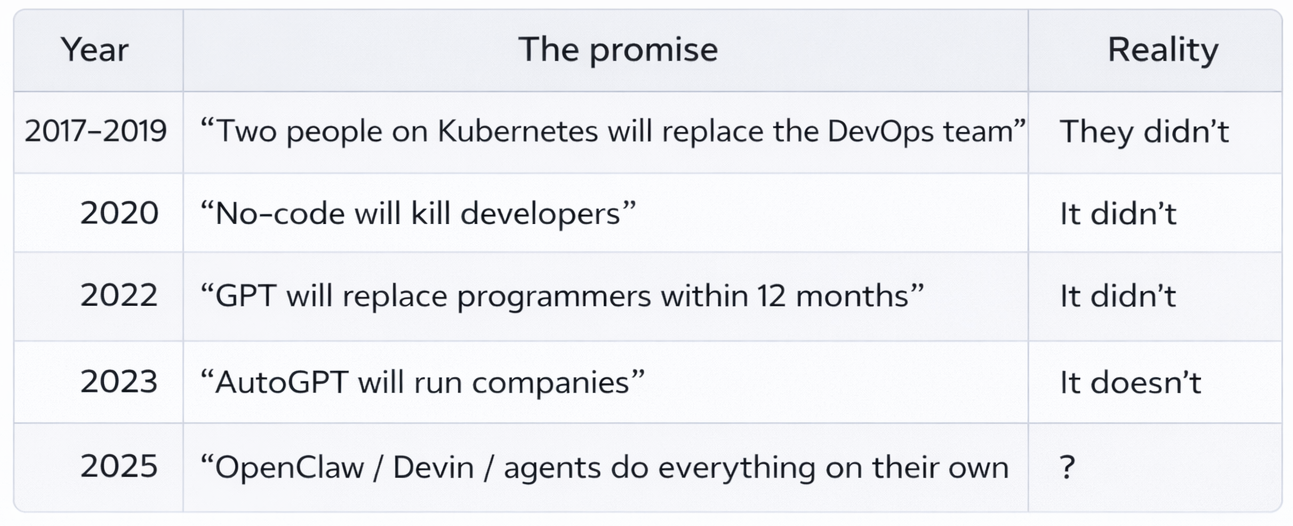
Today, the industry sits between hype and correction—not at the finish line.
From capacity to capability
Services businesses traditionally sell hours. Teams are staffed, time is billed, and revenue scales with headcount.
A different model is beginning to emerge—one where organizations sell outcomes produced by highly leveraged teams. A single strong engineer combined with an AI stack and automation layer can now deliver the output once expected from several people.
Transitions like this unfold slowly. Contracts, procurement cycles, budgeting structures, and organizational design all introduce inertia that delays visible change.
What to do: a practical framework
If you’re a CTO or tech lead
Radical technology leaps almost never happen through mass layoffs. They happen through gradual restructuring of unit economics.
- Measure output per engineer. This is your primary indicator. Not lines of code — business outcome per engineer. If that metric is growing with AI, you’re on the right track.
- Launch limited production use cases. Not “everything on agents.” One workflow, with metrics, with controls, with the ability to roll back.
- Do the math. Token costs, retries, supervision, errors. If you can’t calculate cost per outcome, it’s not production yet.
- Watch revenue per employee at public services companies. That will be the real tectonic signal. Not Twitter posts.
We started small ourselves: tracking AI token costs per project, measuring cycle time before and after agent adoption, running limited use cases with instrumentation. Not a revolution — a calibration.
If you’re an engineer
- Learn to work with agents. AI amplifies those who can define tasks, verify output, and understand system context.
- Invest in understanding the “boring” things: architecture, testing, observability, disaster recovery. These are what AI still does poorly — and what’s becoming critically important.
- Don’t chase every release. Perpetual beta is a trap. Build a position, build systems.
Where the market splits next
Two camps are forming. One focuses on demos, autonomy, and viral narratives with little production depth. The other concentrates on accounting for AI, controlling cost, governing usage, and redesigning delivery.
The second group captures the economic value.
AI will not eliminate services businesses, but it will eliminate inefficient ones.
The defining question of the next few years becomes clear: Do we build the world for agents, or agents for a managed world?
DHH bets on the former. Enterprise historically moves toward the latter.
My answer: both approaches will converge. But the value will accrue to those who manage the transition, not those who launched the first demo.
Bottom line
AI agents are not noise. They mark a structural shift in how software is built.
Markets rarely collapse overnight. They redistribute efficiency over time.
The winners will not be those who launch the first demo. They will be those who rebuild their operating model first.