

Cutting WebPR's Merchant Data
Error Rate by 81% with Amazon Bedrock

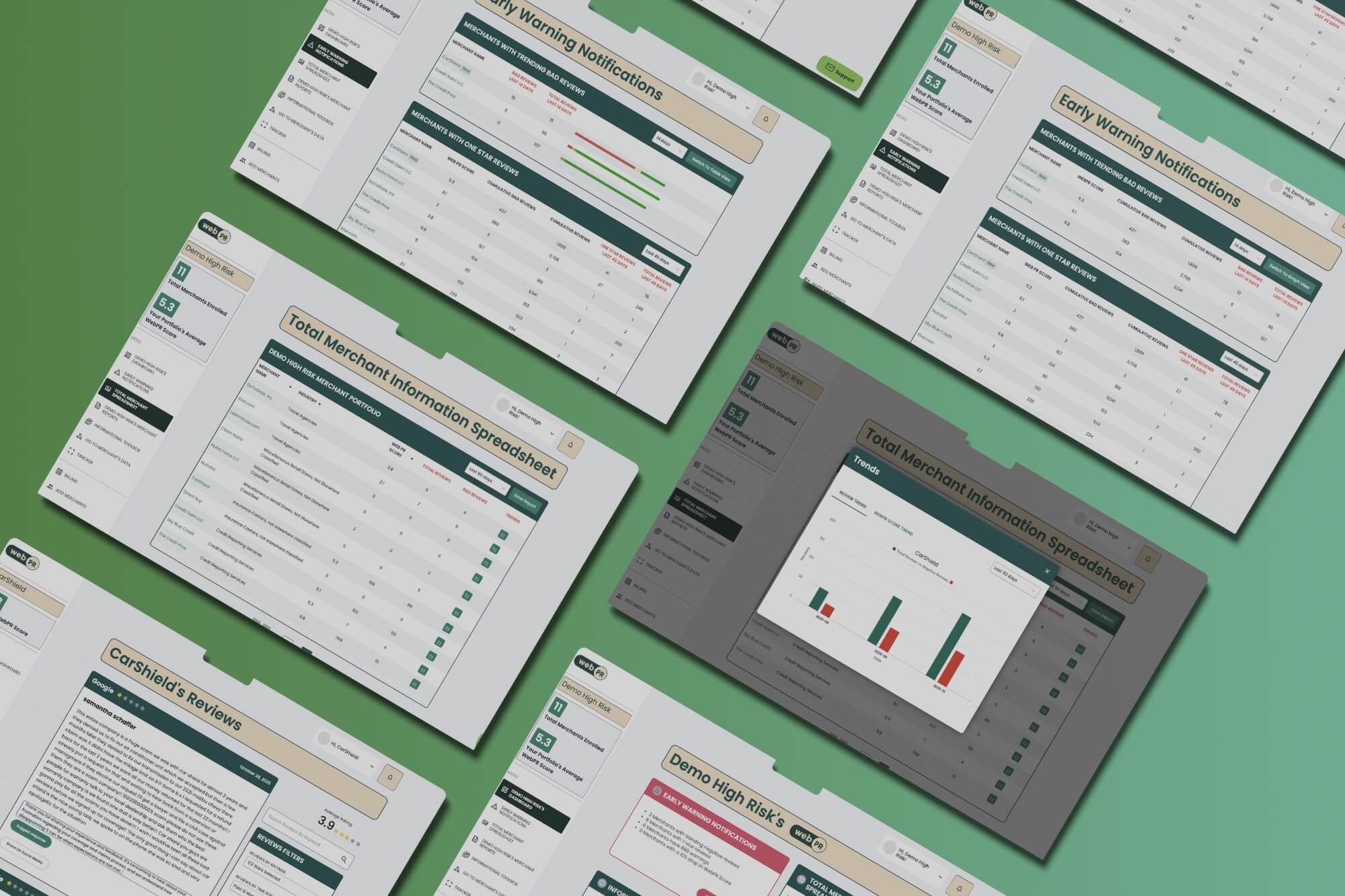
WebPR provides merchant risk and online reputation intelligence to financial service providers, including merchant acquirers and independent sales organizations. The platform aggregates reputation, review, and business-listing data from more than 100 external sources, resolves it into merchant profiles, and scores those profiles to support underwriting, portfolio monitoring, and risk decisions. As a small and medium business SaaS provider, WebPR competes on the accuracy and freshness of its data rather than on headcount.
The Opportunity
Merchant data arrives inconsistently. The same business appears across sources under different legal names, trade names, address formats, and category taxonomies; reviews arrive as unstructured free text; listings go stale. WebPR’s original pipeline handled this with rules-based normalization on Amazon EC2 instances, backstopped by manual engineering QA. Roughly 20% of merchant records carried missing or duplicated data, and a full ingestion batch took approximately two hours with manual oversight to manage traffic spikes and source failures.
The consequence landed downstream. Duplicate merchant records inflate portfolio counts; missing attributes weaken risk scores; stale sentiment misrepresents a merchant’s current standing. WebPR’s customers make underwriting decisions on these outputs, so data defects translate directly into mispriced risk and eroded customer trust. Meanwhile, the manual QA load scaled linearly with data volume: growth made the problem worse, and the engineering time spent on data cleanup was time not spent on product.
Rules-based normalization had reached its ceiling. Resolving whether two differently formatted records describe the same merchant, or classifying the sentiment of a free-text review, requires genuine language understanding rather than pattern matching.


The Solution
Dualboot Partners designed and implemented a production generative AI data curation platform on AWS, replacing manual rules-based curation with an Amazon Bedrock intelligence layer inside a containerized, horizontally scalable architecture.
Amazon Bedrock as the curation engine
Bedrock foundation models, invoked through the Bedrock Converse API from containerized microservices, perform the work that rules could not: detecting duplicate merchant records across inconsistent source formats, normalizing fields into a canonical schema, enriching missing attributes, and classifying sentiment across unstructured review text. Model selection was run against Dualboot’s standard framework: output quality, context window requirements, latency, cost, and data-handling posture. Structured JSON output enforcement constrains model responses to the target schema, prompts and model configurations are held under version control, and every response is schema-validated before persistence, so a malformed generation fails closed rather than corrupting the data store. Bedrock model-invocation logging flows to Amazon CloudWatch.
Compute, storage, and data flow
Amazon ECS on AWS Fargate runs the containerized ingestion and processing services, pulling continuously from the 100-plus upstream sources and staging raw data into Amazon S3 and Amazon DocumentDB:
- Bedrock-invoking microservices curate the staged data. Results split by shape: curated structured records go to Amazon RDS for PostgreSQL, unstructured review content to DocumentDB, and both feed WebPR’s portfolio-scoring and reporting APIs.
- Amazon ElastiCache for Redis reduces read latency on hot paths.
- Amazon ECR holds versioned container images with lifecycle policies and vulnerability scanning.
- Amazon EKS was rejected as adding unnecessary operational complexity at this scale. AWS Lambda was unsuitable for long-running ingestion that needs persistent state and predictable throughput.
Security and networking
The platform runs in a single VPC spanning two Availability Zones. Public subnets carry the Application Load Balancer and ECS ingress; private subnets host the ECS processing tasks, RDS PostgreSQL in Multi-AZ configuration, the DocumentDB replica set, and interface VPC endpoints. No database endpoint is publicly reachable. AWS Secrets Manager delivers runtime credentials with automated rotation, AWS KMS encrypts data at rest and in transit across S3, RDS, DocumentDB, and logs, and AWS IAM task roles enforce least privilege across every ECS service and data store.
Operations and repeatability
Amazon CloudWatch centralizes ingestion metrics, ECS logs, database and Bedrock invocation telemetry, and latency alarms, driving ECS Service Auto Scaling and proactive fault detection. RDS storage auto-scales with read replicas; DocumentDB scales through replica additions. The entire environment is defined in Terraform infrastructure as code, making the multi-tenant architecture reproducible for future deployments rather than a one-off build.
The Impact
Data quality improved materially against the defect that motivated the engagement, measured through WebPR’s QA pipeline before and after Bedrock integration.
- Error and duplication rate down 81% The rate fell from approximately 20% to 3.8% within three months, beating the target of under 5%.
- Attribute completion above 90% through generative enrichment.
- Batch processing time down 66% The ECS and Bedrock pipeline processes an equivalent data batch in approximately 40 minutes against a two-hour baseline, with auto-scaling absorbing variable load without manual intervention.
- Manual QA effort down more than 50% recovering approximately 400 engineering hours a year for product development.
- 99.9% uptime, with monthly infrastructure cost down 14% through managed services, right-sizing, and auto-scaling.
WebPR now onboards merchants faster, delivers more accurate portfolio analytics to acquirers and ISOs, and grows data volume without growing QA headcount.

About the Partner
Dualboot Partners is a nearshore software product development firm of approximately 400 engineers, designers, and product leaders, building and scaling software for venture-backed and private-equity-owned companies across financial services, healthcare, public safety, and industrial sectors. Dualboot pairs embedded product teams with AWS-native architecture and delivery practices, and holds AWS Advanced Tier Services Partner status and the AWS Small and Medium Business (SMB) Competency.