

Compressing Aerospace Standards
Processing from 30 Hours to 30 Minutes with Amazon Bedrock
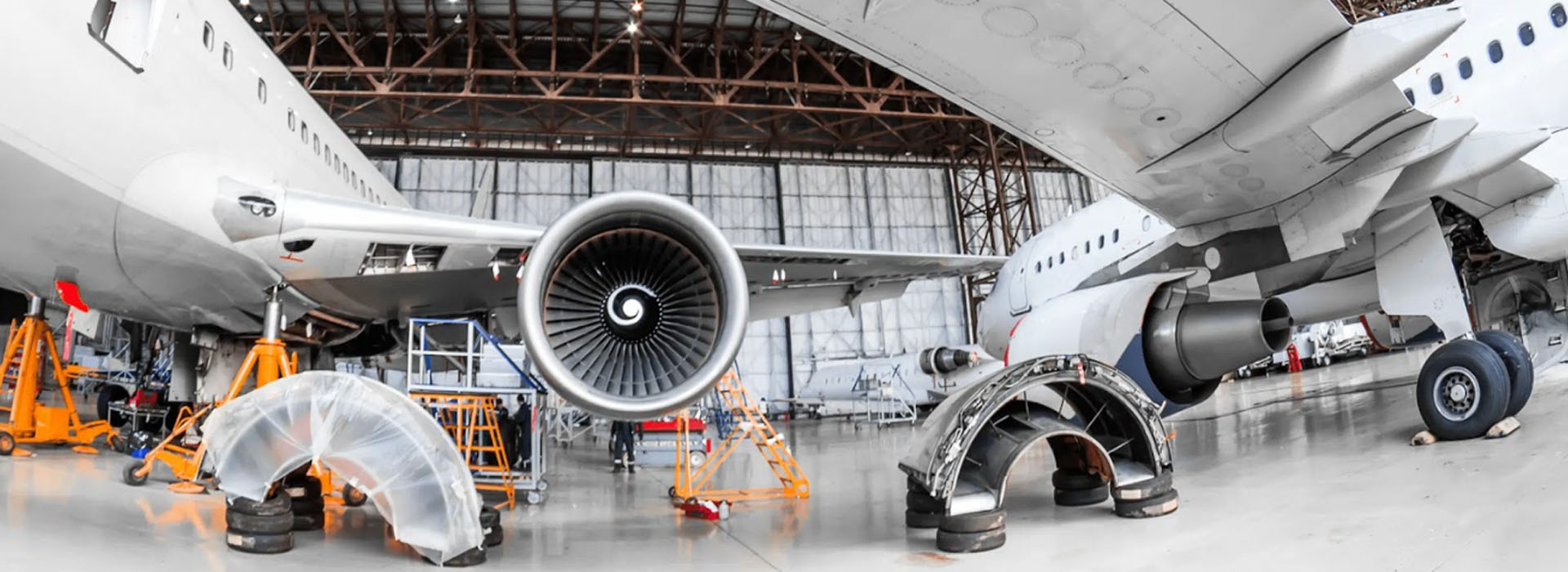
WG Henschen, an Abound Aerospace company, is a master distributor of aerospace and defense hardware founded in 1959 and headquartered in Scottsdale, Arizona. The company supplies general hardware, ring-lock products, and specialized tooling to more than 6,000 customers worldwide, providing supply-chain services including kitting, vendor-managed inventory, and build-to-print capability to OEMs, MROs, airlines, and military customers. WG Henschen holds industry approvals from major aerospace and defense organizations including Airbus, Boeing, Lockheed Martin, and Raytheon.
The Opportunity
Aerospace hardware is specified through standards documents: the AN, NAS, HL, and MISC families that define how a valid part number is constructed. A single standard specifies which dimensional codes, material codes, finishes, and dash sizes are permissible, and which combinations are legal. To quote an RFP or fulfill an order, WG Henschen needed those rules and the resulting valid part numbers as structured data in its NetSuite ERP.
Producing that data was entirely manual and entirely specialist. An estimator read the standard’s drawing block, its dimension and material tables, and its descriptive paragraphs, then hand-transcribed the part-number formation rules and enumerated the valid permutations before keying the result into NetSuite. The scale is not intuitive: a single standard such as NAS1161 yields 36,864 valid part-number permutations. Each drawing consumed roughly 30 hours of skilled work, and WG Henschen processes more than 500 drawings per year. At approximately $60 per hour for a qualified aerospace estimator, this represented on the order of $900,000 in annual labor.
- Throughput: manual extraction could not scale to the working corpus or keep pace with issuing bodies revising and superseding standards.
- Quality: hand-transcription is sensitive to subtle errors, and a missing dash size, an incorrect material-code mapping, or an inverted conditional propagates into the enumerated catalogs used for engineering and procurement decisions.
- Knowledge concentration: only three people in the company could perform the work reliably, with roughly a three-month ramp to train a new estimator, making a core revenue function dependent on a handful of individuals with no bench depth.
Conventional OCR and template extraction could not solve it. Every standard uses a different visual layout, different abbreviation conventions, and different rule structures: single-table, multi-table, and conditional tables with cross-references. Reading them correctly requires document understanding, not pattern matching.


The Solution
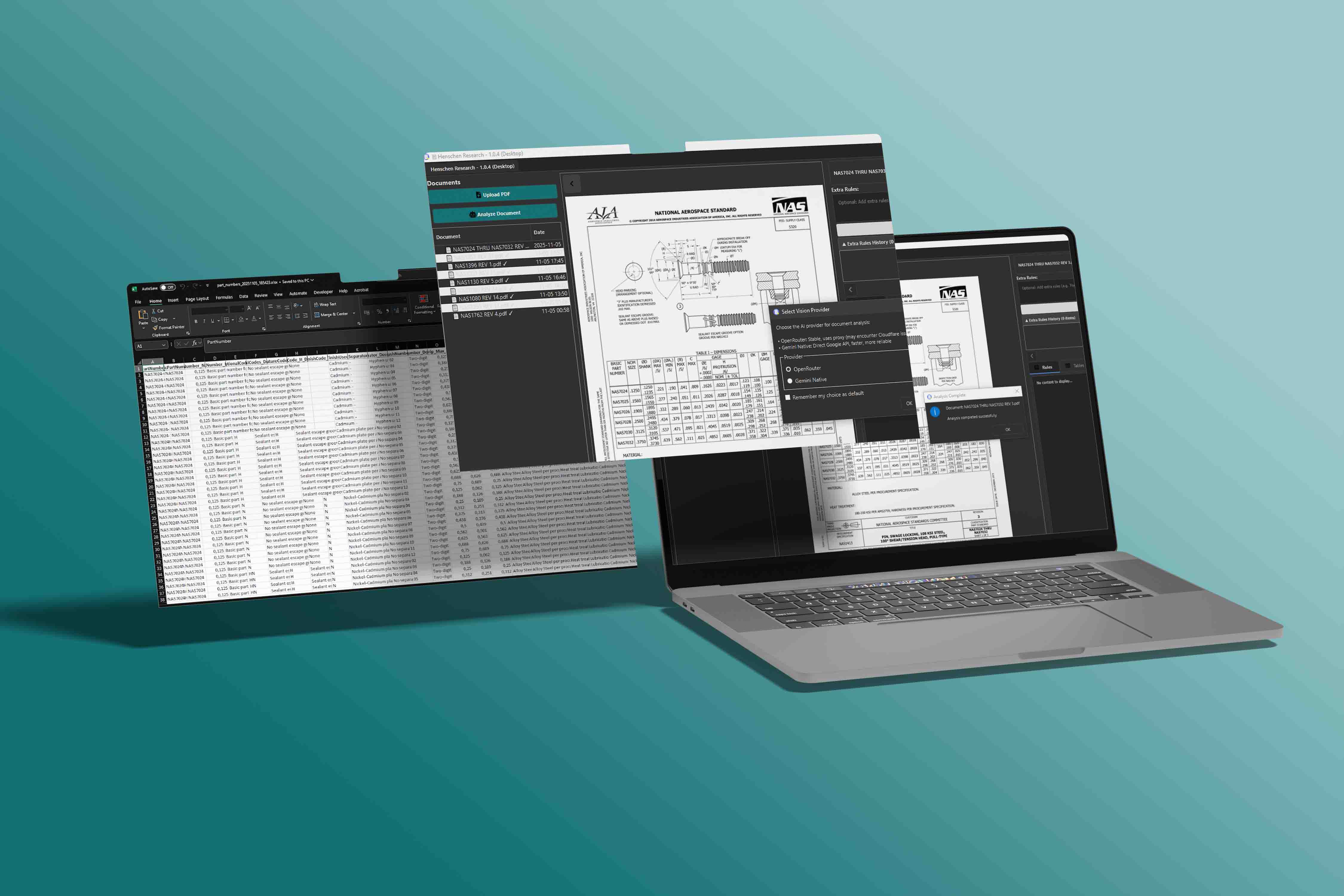
Dualboot Partners built an AI-driven standards analysis application that converts standards PDFs into structured part-number rules and validated enumerations, using multi-modal foundation models on Amazon Bedrock as the extraction engine and keeping a senior engineer accountable for the final output.
Multi-modal extraction on Amazon Bedrock.
The application renders each PDF page to high-resolution raster images and submits them to a multi-modal foundation model on Amazon Bedrock, clamping render resolution so that combined multi-image requests stay within the model’s practical pixel budget. This preserves the visual relationship between a drawing, its embedded tables, and the explanatory text around them: context that text-only OCR discards, and precisely the context an estimator relies on when reading a standard by eye.
An application-orchestrated pipeline, not a model-planned one.
Dualboot implemented a fixed multi-invocation chain with explicit hand-offs between stages, encoded in the product rather than dynamically chosen by the model. That’s a deliberate design decision for an output that feeds procurement:
- Pages are rasterized and staged in a local analysis store with per-document status tracking.
- A background worker runs the long-running passes so the interface stays responsive.
- Consolidated rules and table context produce schema-validated refinement output.
- A separate reporting pass has the model emit Python that builds the enumeration workbook locally, keeping the permutation step explicit and inspectable rather than an opaque completion.
Human in the loop by design
Engineers can supply an “extra rules” override that re-runs the refinement pass with priority instructions, keeping the senior engineer accountable for the final result. Model self-reported confidence scores are validated against actual correctness; any field falling below the confidence threshold is automatically flagged and routed to human review rather than accepted. Every correction is logged, timestamped, and fed back into the next run, so the confidence model continuously calibrates against real outcomes. This aligns with Dualboot’s Responsible AI Policy commitment to human oversight on high-stakes outputs.
Validated delivery into the ERP
Extracted rules and generated enumerations are validated against expected permutation counts before delivery into NetSuite, so structured output entering the system of record has passed an arithmetic check as well as a semantic one.
The Impact
Processing time collapsed, and accuracy held up under an exact audit standard.
- Processing time down from 30 hours to under 30 minutes per drawing, a half-week effort reduced to a same-day turnaround. Baseline is the average manual time to read a standard, extract the rules, validate permutations, and key the result into NetSuite; actual is per-drawing processing time in the deployed solution.
- Field-level accuracy above 95% beating the original 85% target. The audit standard is exact: output must match expected part-number permutation counts precisely, 36,864 for NAS1161, so a near-miss fails rather than passes silently.
- Approximately $880,000 in net annual recoverable value: about $900,000 in gross labor value recovered against roughly $20,000 a year in AI operating cost.
- Key-person risk removed The work no longer depends on three specialists with a three-month training ramp; the extraction capability now lives in a repeatable pipeline, with senior engineers reviewing exceptions instead of transcribing every rule by hand.
WG Henschen can now respond to RFPs and orders at a pace its manual process could not support, and can absorb standards revisions as they’re issued rather than as staffing allows.
About the Partner
Dualboot Partners is a nearshore software product development firm of approximately 400 engineers, designers, and product leaders, serving venture-backed and private-equity-owned companies across aerospace and industrial distribution, financial services, healthcare, and public safety. Dualboot specializes in applying generative AI to document-intensive industrial workflows where accuracy is auditable and expertise is scarce, and holds AWS Advanced Tier Services Partner status and the AWS Small and Medium Business (SMB) Competency.